
Waabi just closed a $1 billion funding round and struck an exclusive partnership with Uber to deploy 25,000 robotaxis. It’s the largest tech raise in Canadian history. The headlines focus on the AI, the simulation technology, the competitive positioning against Waymo and Aurora.
From our (Rooted’s) perspective, here’s what the headlines miss: the hardest part isn’t actually building the autonomous vehicle. It’s rebuilding the organization around it.
This leads back to the question:
When robots
drive the truckswrite the codework the machines
who drives the change?
Answer: Humans
When robots drive the trucks,
and operate the machinery
who drives the change?
Answer:
Humans.
The Part Where the ‘Capacity Problem’ Meets the ‘Transformation Problem’
The U.S. trucking industry is short 80,000 drivers right now (woah). That number’s expected to double by 2030. Average driver age is 46. Turnover at some large carriers exceeds 90% annually.
It’s safe to say that the trucking sector of the Logistics and Transportation industry has it’s fair-share of problems. Problems like the capacity crisis, for instance, are issues that that autonomous trucking would actually solve.
But it also creates a different kind of crisis. This one shows up in your org chart, your communication patterns, and your operational workflows before a single autonomous vehicle even hits the road.
Waabi’s technology is impressive. Their “Physical AI” uses simulation to train autonomous systems without requiring billions of real-world miles. The same AI brain powers both trucks and robotaxis. It’s capital-efficient, fast to deploy, and backed by NVIDIA, Volvo, and now Uber.
None of that matters if your organization can’t adapt to use it.
Three Friction Points Leaders Don’t See Coming
We work with logistics and transportation companies navigating major technology transformations. The autonomous vehicle conversation always starts with ROI calculations and deployment timelines.
It should start with organizational readiness and here’s why:
1. Your network breaks before your processes do.
When you remove the driver, you remove the central coordination point for dozens of daily micro-decisions. Who owns the relationship with the customer when there’s no driver making the delivery? How does your dispatch team coordinate with remote fleet operators they’ve never worked with? What happens to your safety protocols when liability shifts from human error to AI decision-making?
These aren’t necessarily process questions, but rather network related questions. Your informal communication pathways—the ones that actually make your operation run—are built around human drivers. Remove them, and information stops flowing to the right people at the right time.
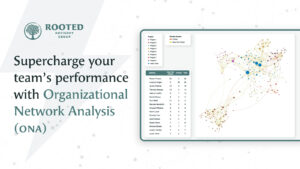
Organizational Network Analysis can map these invisible pathways before they break. You need to see how decisions actually get made, where information bottlenecks exist, and who the real connectors are in your operation. Then you can redesign around the new reality.
2. New roles emerge faster than org structures adapt.
3. Old processes assume drivers exist.
What Rooted Brings to This
We’re not autonomous vehicle consultants. We’re organizational transformation specialists who happen to work with companies navigating autonomous vehicle adoption.
The difference matters. Waabi can build the AI. Volvo can build the truck. Uber can build the platform. But nobody’s building your organization’s capacity to use any of it effectively.
That’s where Organizational Network Analysis, Change Management, and Business Process Engineering create value. We help you see the invisible structures that make your organization work, redesign them for the new reality, and bring your people along in the process.
The Real Question
The Waabi-Uber deal is a bet that simulation-first AI can scale autonomous driving faster and cheaper than competitors. It’s probably a good bet. The technology is real. The timeline is aggressive but plausible. The capital is there.
But technology adoption isn’t a technology problem. It’s an organizational problem.
The question isn’t whether autonomous trucks will transform logistics. They will. The real question is whether your organization can transform fast enough to deploy them successfully.
Most companies find out the answer after they’ve already committed to the technology. That’s expensive. Better to find out now, while you can still do something about it.
Change happens.
Growth is a choice.
At Rooted, we help organizations adapt without losing themselves. As industries shift, we guide teams through transformation using strategies that actually stick. We think it through, then we help you build it right.